
Medium-ware

Original Writeup on seall.dev
This challenge was the most brutal one for the week, a PLC based challenge (which I have next to no experience in, apart from SCONES 2024 which had the same author as the hardware challenges there for this challenge).
From previous experience with these kinds of challenges, and some searching, we start with the firmware.hex with Ghidra.
I start by making a project, the usual Ghidra setup, then I import the file.
I search ‘AVR’ as indicated in the challenge prompt, and look at the available languages:
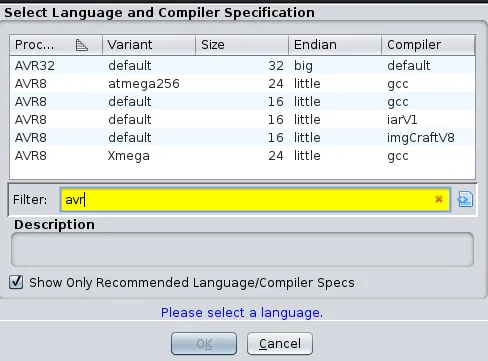
I select AVR8 and select the size 16 GCC version, as I did in my SCONES 2024 writeup.
I open it up in the CodeBrowser, and for analysis select my options.
Then, I Select All options, Apply, then Analyze.
Once that’s complete, we know we are looking for a hard-coded secret, the hints suggest looking at the 0x02d2 offset to start.
We can see a faily trivial looking function:
void FUN_code_027b(void)

{
  do {
                    /* WARNING: Do nothing block with infinite loop */
  } while( true );
}
but below is what looks like an interesting string:
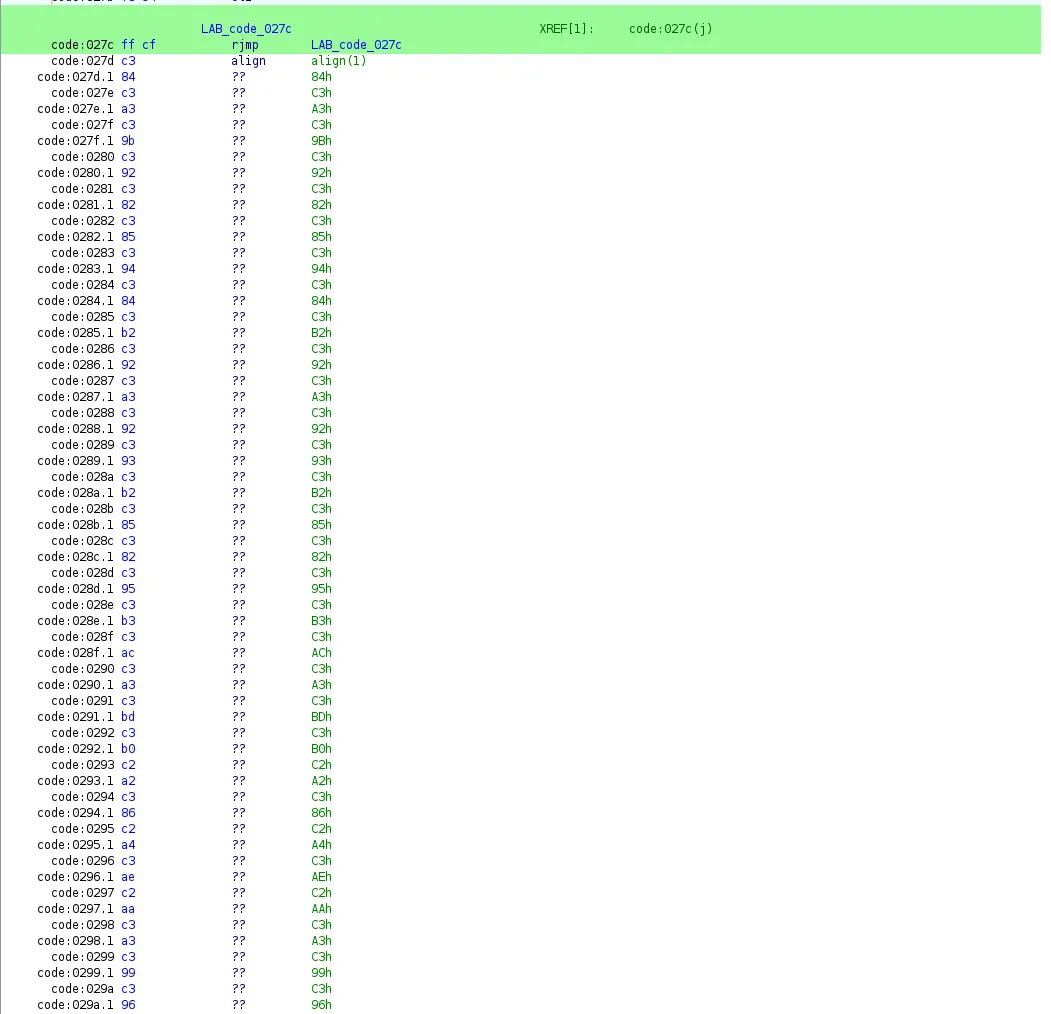
I then do a Search > For Encoded Strings....
Some are filtered, so I disable the Exclude codec errors filter in Advanced...
There’s only one, at the 0x027d as suggested in the string, this seems interesting!
I press Create All to create the strings.
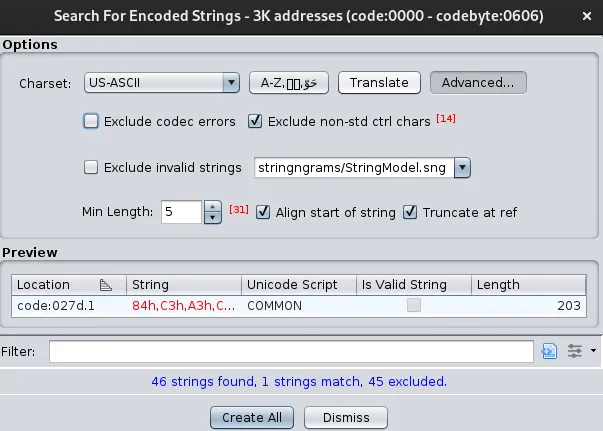
If you copy the ‘Encoded String’ its missing a C3 at the start

I copy the full string and manually add the C3h, to the start:
C3h,84h,C3h,A3h,C3h,9Bh,C3h,92h,C3h,82h,C3h,85h,C3h,94h,C3h,84h,C3h,B2h,C3h,92h,C3h,A3h,C3h,92h,C3h,93h,C3h,B2h,C3h,85h,C3h,82h,C3h,95h,C3h,B3h,C3h,ACh,C3h,A3h,C3h,BDh,C3h,B0h,C2h,A2h,C3h,86h,C2h,A4h,C3h,AEh,C2h,AAh,C3h,A3h,C3h,99h,C3h,96h,C3h,88h,C3h,81h,C3h,BCh,C3h,A5h,C3h,94h,C3h,9Bh,C2h,A4h,C3h,80h,C3h,92h,C3h,A1h,C2h,BCh,C2h,A7h,C2h,B0h,C3h,80h,C3h,BCh,C3h,B3h,C3h,82h,C3h,A5h,C3h,88h,C3h,B9h,C3h,A0h,C2h,AEh,C2h,B8h,C3h,A5h,C3h,B1h,C3h,8Dh,C2h,AEh,C2h,A7h,C3h,BEh,C3h,91h,C3h,B6h,C3h,96h,C3h,80h,C2h,A6h,C2h,B8h,C3h,A3h,C3h,B6h,C3h,99h,C3h,99h,C2h,A4h,C3h,A7h,C3h,9Bh,C2h,A0h,C3h,99h,C2h,B8h,C2h,A2h,C3h,A0h,C3h,8Fh,C2h,A1h,C3h,B9h,C3h,B1h,C2h,A2h,C3h,B3h,C2h,B8h,C2h,A4h,C3h,85h,C3h,80h,C2h,A0h,C3h,93h,C3h,99h,C2h,AEh,C2h,AAh,C3h,A3h,C2h,AFh,C3h,93h,C3h,9Bh,C3h,B4h,C2h,AAh,C3h,86h,C3h,AAh,C3h,9Bh,C3h,99h
We know an XOR is being used from the hint, so I look up the manual for the AVR8’s.
Looking for the XOR symbol, I find the EOR operation.
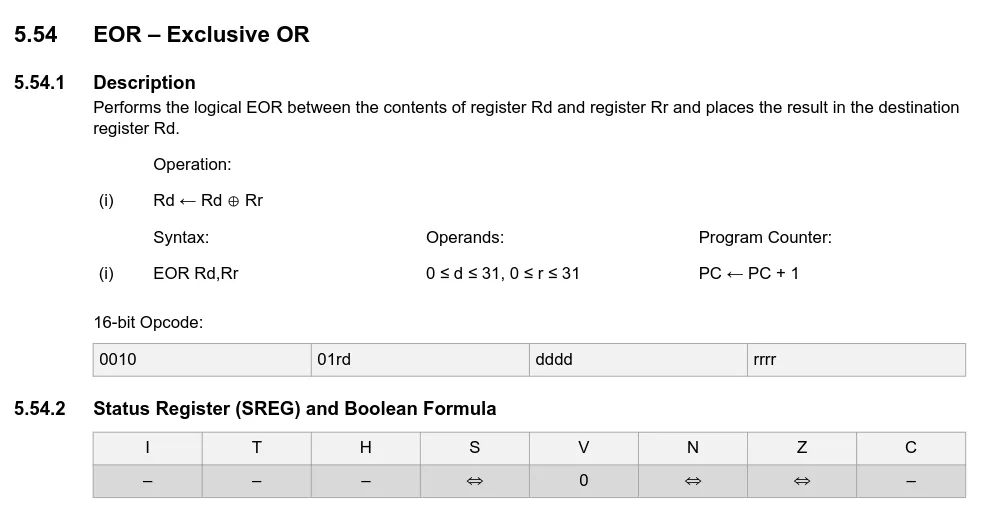
I then search the Program Text for any instances of eor.
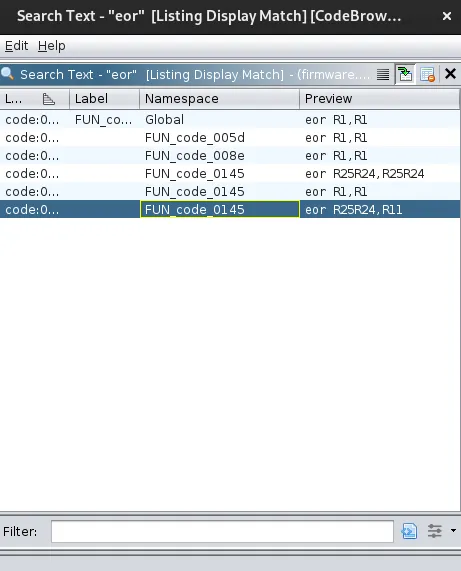
The last result has the XOR with 0x61, which is 97 as we expect in the hint.
This is the code snippet of interest:
X = R13R12;
R15R14._1_1_ = *R13R12;
if (R15R14._1_1_ == 0) break;
R25R24 = (byte *)FUN_code_00f5((char *)R25R24,R23R22,R21R20,R19R18);
R25R24 = (byte *)(CONCAT11(R25R24._1_1_,R15R14._1_1_) ^ 0x61);
R17R16 = &DAT_mem_85c7;
...
R13R12 = (byte *)CONCAT11(R13R12._1_1_ + R1R0._1_1_ + (0xfc < (byte)R13R12),
                    (byte)R13R12 + 3);;
It is doing the XOR operation we expect, then adding 3 each time, so only selecting the 0th, 3rd, 6th, etc characters.
I then make a CyberChef recipe to do the whole process.
The issue we had was noticing the UTF-8 as in Cyberchef, the output automatically visually adjusts to detected decoding, but works with the raw output.
Flag: SECEDU{g3t_r3v'd_9f0a1a375653798c}
Further Notes
During the challenge we were also provided some other files that were mostly red herrings, but helped with figuring out the XOR and every 3rd character functions.
Inside a given PLC.ino.lst file, there is some information about a ‘secret code’.
void blinkSecretCode() {
  for (int i = 0; portData[i] != '\0'; i+=3) {
    blankLEDs();
    blinkLEDsOnPattern(portData[i]^97);
 410:	41 e6       	ldi	r20, 0x61	; 97
 412:	b4 2e       	mov	r11, r20
}
There we can see that 97 hex for the XOR, and its iterating i by 3.
Inside the PLC.ino.map we can see portData is located at 84fa:
portData |000084fa| r | OBJECT|000000cd| |.rodata /home/tom/Desktop/chal/PLC/PLC.ino:10
We can see in Ghidra the DAT_mem_84fa:
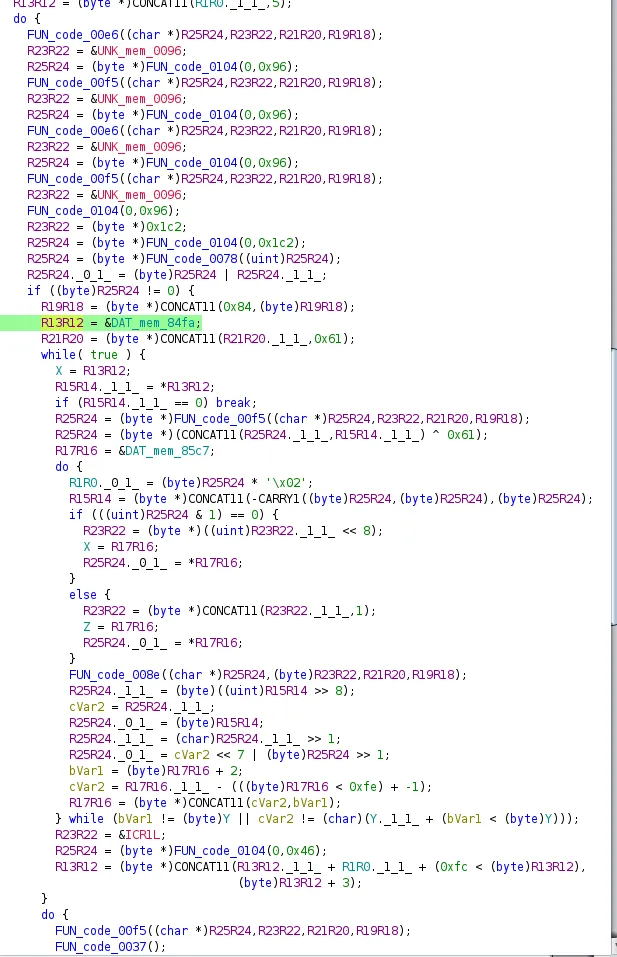
This helps us see where the data is loaded in the decompiled Ghidra code, which helped us with reverse engineering during the first week, this writeup was adjusted to just use the firmware.hex as its possible to solve it with that alone.